AI Translation Errors
What American Translators Association (ATA) states on Artificial Intelligence (AI) and AI Translation Errors:
”Real-world implementation of AI across translation and interpreting workflows—when performed under expert human oversight—can lead to measurable gains in productivity, consistency, and responsiveness, particularly in time-sensitive or high-volume domains.
”As the broader public adopts digital-first approaches, it is imperative that qualified, technically proficient language professionals lead the way in shaping how AI is integrated.
”One of the greatest dangers of AI-generated translations and interpretations is that they may appear accurate to the general observer, making errors harder to detect for those without linguistic expertise.
”Another relevant factor is that the source of information used by AI is continuously evolving and, over time, there is a growing concern about the quality, reliability, and biases of the data it relies on. As AI systems increasingly pull from uncontrolled, unverified, or even manipulated sources, the risk of spreading misinformation, inaccuracies, and flawed translations rises.
”It is also important to highlight that AI translation performance varies widely across language pairs, and users may be unaware of these inconsistencies, mistakenly assuming AI provides uniform quality across all languages.
”In high-stakes scenarios, these potential inaccuracies can have severe repercussions. In fields such as healthcare, legal, and financial translation and interpreting, as well as translation and interpreting for the public sector, no one can afford the risks posed by AI-generated mistranslations or misinterpretations.
”But even private businesses seeking to sell their products or services may mistakenly believe they’re reaching their audience through AI-translated content while their message is lost or distorted, wasting resources and opportunities.
”In all these cases, only a trained professional with deep linguistic and subject matter expertise can ensure accuracy and preserve intended meaning, safeguarding the interests of all parties involved.”
A note on AI Translation Errors in texts aimed at promoting real estate for sale internationally: one can lose advertising money and business reputation due to mistranslations. Don’t publish any raw machine-translated content without knowledgeable human supervision!

Facts of AI Translation Errors from Olga Kellen, English - Russian Translator and Marketer
# An American realtor emails to his Russian partner: “Let’s meet on Zoom to finalize the details of the transaction on 06.07.” The Russian answers “Ok” as he reads the same translated by AI, but thinks that the date of the meeting is the 6th of July, while the American meant the 7th of June! The thing is that Americans write “Month.Day”, but Russians do “Day.Month”, and no AI takes this cultural nuance into consideration. Result: no meeting, maybe no deal, just disappointment.
# An American businessman emails to his foreign partners using an idiom and AI translations (EN>AR>RU): “Plans are still up in the air” (meaning that he hasn’t decided yet), but on the receiving end his business partners read - in back translation into English - “Plans are still outdoors” (thinking why wouldn’t the American bring his plans into the room… and what should they do about it now?)
# Another business email from an American to his foreign partners using an idiom and AI translation (EN>EST>RU): “I’d like to quickly touch base with you” thinking of a quick exchange of ideas, but his foreign partners actually read - in back translation into English - “I’d like to touch panel with you” with a great astonishment that the American offers them to touch together… some wall? board? painting? or what?…
# “1-bedroom” or “1-bed” or “1 b/r” in American English means an apartment with a bedroom and a living room which in Russian would be called “2-room”. You can see AI-translated listings where it says “1-room” or even “one bed” which is not just confusing, but actually would make the advertising money spent uselessly after all, as nobody is going to read further about a dwelling which contains only 1 bed (why?).
# “Infinity pool” in English has no good equivalent in Russian, and AI translations that you might see in real estate listings for sale are awkward or not really true - like “pool with no end” (what’s that?). Solution: toss in the target text something like “large pool where you enjoy direct ocean views while swimming” (or similar depending on the environment).
# American measurements “square feet, yards and miles” are not changed into “square meters, meters and kilometers” in Russian while listings are AI translated, and potential foreign buyers might be turned away as they don’t understand the real sizes of the property for sale as well as its distance from the airport, etc.
AI Translation Errors Kill Your Marketing Message in Russian (without proper human editing / transcreation)
Here are some most often seen - rather typical examples of published marketing texts translated by AI obviously - which immediately tell Russian buyers that the seller doesn’t care about the audience at all:
- In Russian there’s a difference in how you address people - one way to say “you” in a formal, respectful manner talking to adults, and another one if you’re talking to kids or youth. It’s extremely important for your marketing message to use the correct word, but AI doesn’t “read the content” - do you sell kids’ games or expensive homes? Thus, mistakes are often made.
- In Russian there are completely different rules for using words for “he”, “she” and “it” - we don’t go into details here, but believe me it’s so distracting to see “he” when there is a woman in the picture, etc. that you lose the meaning of the text.
Human editing or transcreation (rewriting the AI translated text according to cultural norms in the target language) is a must if you’re serious about your international business.
Feel free to contact me through this website or LinkedIn, where I publish more on the topic.
Sincerely yours,
Olga Kellen,
English - Russian translator,
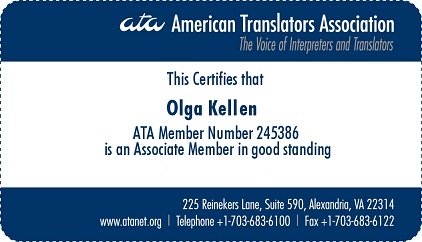
Associate member of ATA
American Translators Association
Contact for all your Marketing to Russians needs and questions
Also for your free English Russian translation quote